
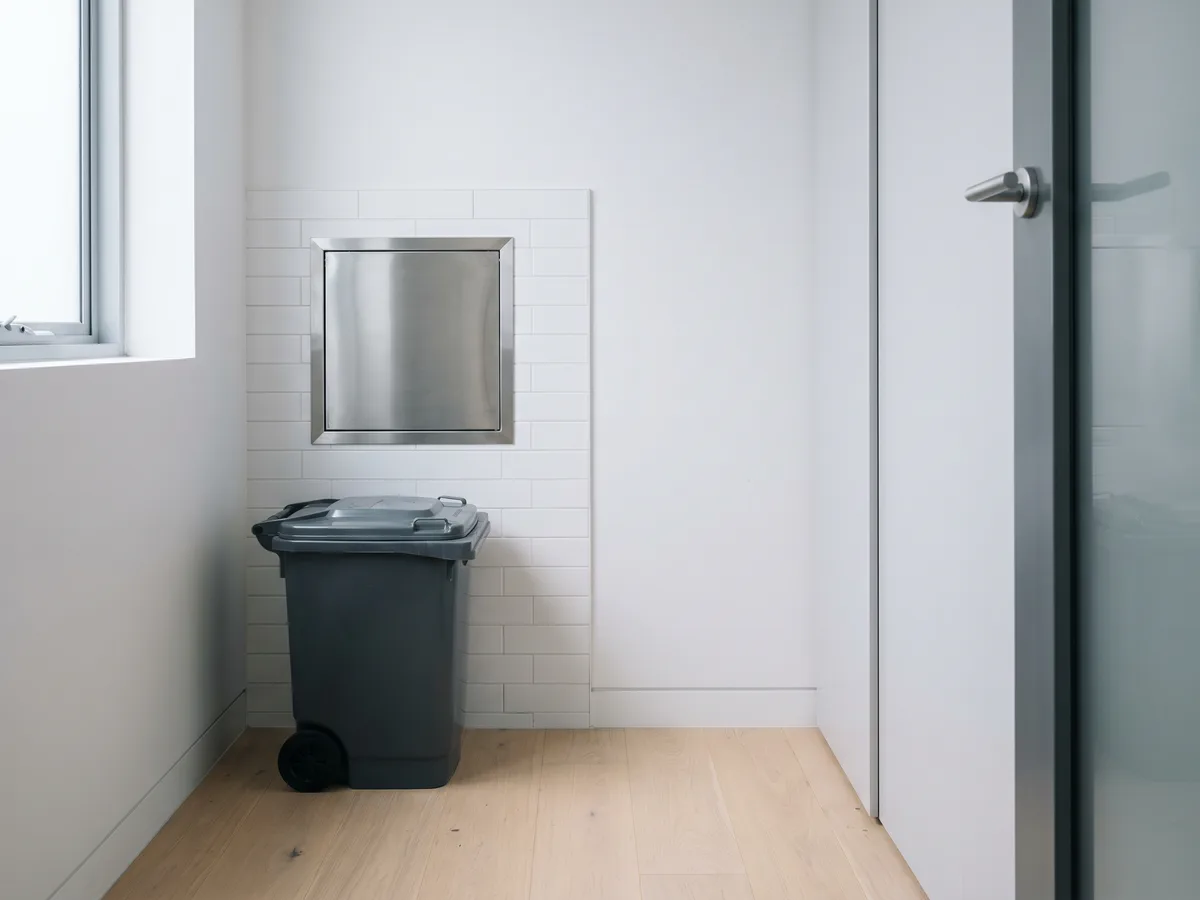
The chute takes nothing bigger than a bag
Every tower has one: the little stainless hatch that swallows the daily rubbish and politely refuses everything interesting. This guide is about the other path, the one a sofa, a mattress or a dead fridge actually takes from level fourteen to a truck, and why it involves more phone calls than lifting.
Step one: the item never travels alone
In a house, a sofa's exit is a doorway. In a tower it's a route: apartment door, corridor, lift lobby, goods lift, ground corridor, dock or street door, and every surface on that route belongs to the building, not to you. That's why buildings have rules about moving big things, and why the rules aren't bureaucracy, they're how three hundred households share one set of corridors without the walls looking like a skate park.
The goods lift is the whole game
Most buildings require the goods lift (or the padded "lift number two") to be booked for anything bigger than a suitcase, often days ahead at busy times of the month, usually through the building manager or concierge. The booking gets you the lift held on your floor, the protective curtains hung, and a window where you're not fighting a furniture delivery going the other way. Miss the window and you're renegotiating with whoever booked the next one.
Many buildings also want paperwork from any crew doing the moving before they'll confirm the booking. When we do the job, that whole conversation is ours: we call the building, produce whatever they ask for, and book the window. It's part of the fixed price because it's part of the job.
Padding is not optional
The route gets protected before the item moves: blankets on the lift walls if the curtains aren't hung, corner guards where the corridor turns, the door saddle taped. A fridge takes chips out of paintwork with astonishing efficiency, and a building manager who finds gouges after a job will remember your apartment number for years. Slow and padded beats fast and sorry in every building we work.
Docks, lobbies and the no-dock building
Where there's a loading dock, the truck's window has to line up with the lift's, docks have their own bookings and their own hours, often tighter than the lift's. Where there's no dock, it's the lobby and a legal place for the van, which in the city core is its own small art. Buildings on lanes, or with nothing at all, we walk it out to wherever the van can lawfully sit and plan the carry around that.
The walk-up variation
No lift means shoulders and stairs, and it changes the crew count, not the method: same padding, same protection, more hands on the heavy end. Darlinghurst's deco stock is the classic case and it has its own page, but the rule generalises: stairs belong in the price you're quoted up front, never in a surcharge invented at the bottom of them.
What this means for you
If you're doing it yourself: call your building manager first, book the lift, borrow real blankets, and give yourself twice the time you think. If you're booking us: tell us the building and we already know the rest, the lift booking, the padding, the dock window and the paperwork are all inside the one fixed price.
Tell us the date. We'll handle the building.
Send what needs to go and when the keys go back. We'll come back with one fixed price, agreed before we lift a thing, and we'll sort the goods lift with your building manager.